What Mattress Firmness Is Best for Back Pain
Medium-firm is the mattress firmness most consistently linked to less back pain and better sleep quality, according to a review of clinical studies published by the National Library of Medicine. But "medium-firm" is not one answer for everybody. A stomach sleeper and a side sleeper can need opposite firmness levels even while dealing with the exact same ache in the exact same spot.
If your mattress is sagging, too soft to hold your hips level, or too hard to let your shoulders settle, your back pays for it every night. The fix is not "buy the firmest bed you can find." It's matching firmness to how you actually sleep, then checking that the mattress supports your lower back specifically, not just your body weight in general.
At a glance: firmness by sleep position
What causes mattress-related back pain?
Mattress-related back pain almost always comes down to one of three things: sagging support, a firmness mismatch for your sleep position, or a mattress that's simply past its prime. A mattress that dips in the middle can't hold your spine in its natural alignment, and that gap under your lower back is exactly where morning stiffness starts. The National Council on Aging notes that a mattress that sags or dips in the middle may fail to support spinal alignment, causing back pain to build over time.
Firmness mismatch is the other big culprit, and it cuts both ways. A surface that's too firm won't let your shoulders and hips sink in enough, which can leave your neck and lower back without real support and contribute to joint stiffness. A surface that's too soft lets those same areas sink too far, pulling your spine out of alignment in the opposite direction. Research reviewed in the Journal of Orthopaedics and Traumatology points to this middle ground, not too firm, not too soft, as the sweet spot for most sleepers with back pain.
What mattress firmness is best for back pain, by sleep position?
Your sleep position should drive your firmness decision more than any general "back pain" recommendation floating around online. Back and stomach sleepers generally do better on medium-firm to firm surfaces, because a firmer feel keeps the hips from sinking and the spine from bowing out of neutral. Side sleepers usually need the opposite: a medium to plush feel that cushions the shoulder and hip, since those two points carry the most pressure when you're lying on your side. Combination sleepers, who shift positions through the night, tend to land on medium as the workable middle ground, mostly because it's the setting least likely to fight them in any one position.
Body weight complicates the picture too, and people underestimate this. A firm mattress that feels supportive to a 240-pound back sleeper might feel unyielding to a 130-pound side sleeper, simply because weight changes how much any given surface compresses. If you're not sure where you fall, Serta's sleep position guide walks through firmness by position, and the mattress quiz can narrow things down faster if you'd rather answer a few questions than guess.
Why does lumbar support matter as much as firmness?
Firmness alone doesn't guarantee good lumbar support. A mattress needs to contour at your lower back and hips specifically, not just feel uniformly hard or soft from head to foot, and this is the part most firmness quizzes skip entirely. Two mattresses can carry the same "firm" label on the tag and feel completely different where it counts, because one has zoned support built into the coils or foam and the other doesn't.
Zoned support typically means alternating firmer and plusher sections positioned to reinforce the lower back and hips while still cushioning the shoulders. Without it, you're relying on uniform firmness to do a job that really needs targeted support, and that's often where a "firm enough" mattress still leaves people waking up stiff. Edge support matters here too, especially if you sit on the edge of the bed to get up. A mattress that collapses at the perimeter isn't doing your spine any favors either, even if the center feels fine.
How do you actually evaluate a mattress for back pain before you buy?
Test it against three things: your sleep position, your body weight, and a real trial period, not a five-minute lie-down in a showroom. A mattress can feel fine for five minutes and feel very different after a full night, and it typically takes a few weeks of regular sleep for your body to register whether a new surface is actually supporting your spine or just feels novel because it's new.
Beyond firmness, look at the construction. Innerspring and hybrid mattresses tend to have more responsive, durable support and are a common recommendation for back and stomach sleepers; all-foam mattresses can give deeper contouring that some side sleepers prefer. Whatever you choose, a longer in-home trial gives you the room to find out if it's actually working for your back, rather than committing on a guess.
Which Serta® mattresses fit the criteria for back pain support?
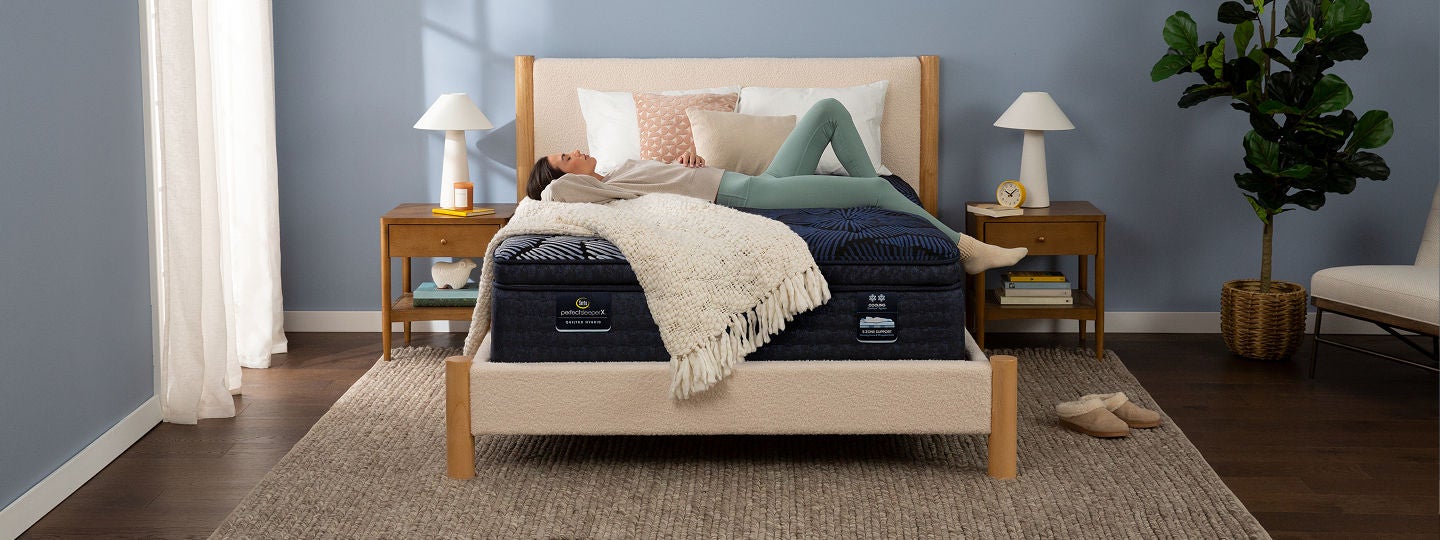
Serta's Perfect Sleeper collection is built around the kind of targeted, position-specific support the research above points to. The Q4™ Support System uses 4-in-1 linked coils to distribute your weight evenly and give the mattress lasting, durable support night after night. Layered on top, the 5 Zoned Comfort design alternates firm and plush zones to reinforce your back and hips while still cushioning your shoulders, which is the zoned support model described above, not just a single firmness rating on a tag. A CoolFeel® Fabric surface handles the temperature side of things; cooling comes from the fabric and cover materials, not the coils underneath.
For back and stomach sleepers specifically, the Perfect Sleeper Cascade Range Extra Firm mattress is built with that sleep position in mind. If you're a combination sleeper who needs a middle-ground feel, a Medium option within the same Perfect Sleeper collection applies the same Q4 and zoned-comfort construction in a softer feel. Every Perfect Sleeper mattress is CertiPUR-US® certified, completely fiberglass-free, and made in the U.S.A. with globally sourced components. It's backed by a 10-Year Limited Warranty, plus a 100-night trial if you buy direct, so you're not stuck guessing after one night in a showroom.
Medium-firm is a reasonable starting point for back pain, but that's all it is: a starting point, not a guarantee. A mattress that's technically medium-firm but has no zoned lumbar support can still leave a back sleeper stiff, while a well-built firm mattress with targeted zones can outperform a generic "medium-firm" label for that same person. The number on the tag matters less than whether the mattress actually supports your specific sleep position, body weight, and lower back, which is exactly why a real trial period, not a showroom test, is where you'll find out for sure. Most people never get past the showroom test, and that's the mistake.
Ready to match your sleep position to the right firmness? Take Serta's mattress quiz and find your fit in a few minutes.
Frequently asked questions
What firmness is best for lower back pain specifically?
Medium-firm is the firmness most often associated with reduced back pain and better sleep quality across clinical research. Your ideal firmness still depends on your sleep position and body weight, though, so treat medium-firm as a starting point rather than a universal answer.
Is a firmer mattress always better for back pain?
No. Older advice leaned hard on "firmer is better," but a mattress that's too firm can prevent your shoulders and hips from sinking in enough, leaving your lower back and neck without real support. The better standard is a mattress that supports your spine's natural curve, which sometimes means firm and sometimes means softer, depending on how you sleep.
What firmness should side sleepers with back pain look for?
Side sleepers with back pain generally do best with a medium to plush feel that cushions the shoulders and hips. A surface that's too firm can create pressure points at those two spots, pulling the spine out of a neutral line even if the mattress feels supportive everywhere else.
Can a mattress that's too soft cause back pain?
Yes. A mattress that's too soft lets your hips and shoulders sink too far, pulling your spine out of alignment in the opposite direction from a too-firm mattress. The goal is a surface that supports your body weight without letting any one area sink dramatically more than the rest.
How do I know if my sleep position needs a different firmness than I'm using?
If you wake up stiff and you know your sleep position, compare it against general guidelines: back and stomach sleepers usually need medium-firm to firm, side sleepers need medium to plush. Serta's shop by sleep position guide breaks this down further if you want a more specific starting point.
Does mattress type, foam, hybrid, or innerspring, matter for back pain?
Mattress type changes how firmness feels in practice, even at the same firmness rating on the tag. Innerspring and hybrid constructions tend to have more responsive, durable support that many back and stomach sleepers prefer, while all-foam mattresses give deeper contouring that some side sleepers find more comfortable.
How long should I test a new mattress before deciding if the firmness is right?
Give it more than a few nights; your body needs time to register whether a mattress is actually supporting your spine or just feels new. That's the reason longer in-home trial periods, rather than a quick showroom test, are the more reliable way to judge firmness for back pain.